How NetApp Improves Data Compliance and Governance
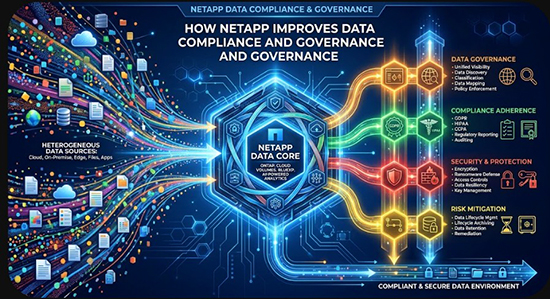
Data has become one of the most valuable assets for modern organizations. Businesses rely on data to make decisions, serve customers, develop products, and maintain daily operations. However, as the volume of information increases, organizations also face greater responsibilities for protecting, managing, and governing that data. Regulatory requirements such as GDPR, HIPAA, PCI DSS, and various national privacy laws make compliance a critical part of enterprise IT strategy. This is where NetApp can play an important role.
NetApp provides data management, storage, security, and governance technologies designed to help organizations maintain greater control over information across on-premises environments, private clouds, and public cloud platforms. By combining centralized data management with security controls and visibility, NetApp helps businesses build a stronger foundation for compliance and governance.
Centralized Data Management
One of the biggest challenges in data governance is knowing where information is stored and how it is being used. Organizations often have data distributed across multiple servers, data centers, cloud environments, applications, and employee systems. This complexity can make it difficult to identify sensitive information and apply consistent policies.
NetApp technologies help organizations manage data across diverse environments. A centralized approach makes it easier for IT teams to understand data locations, monitor storage resources, and establish consistent management policies. Better visibility can reduce the risk of sensitive information being forgotten in unmanaged systems.
Centralized management also supports more efficient auditing. Instead of manually checking numerous storage environments, administrators can use integrated management capabilities to gain a broader view of organizational data.
Protecting Sensitive Information
Data compliance depends heavily on protecting sensitive information from unauthorized access. Personal information, financial records, healthcare data, intellectual property, and confidential business documents require strong security controls.
NetApp supports data protection through technologies such as encryption, access controls, authentication, and secure storage management. Encryption can help protect information both while it is stored and when it is transferred between systems, depending on the organization’s configuration and architecture.
Access control is equally important. Organizations can define who is allowed to access particular resources and restrict unnecessary privileges. Following the principle of least privilege helps reduce the possibility of unauthorized access and limits the potential impact of compromised accounts.
Improving Data Visibility
Effective governance requires organizations to understand their data. Simply storing information securely is not enough. Businesses also need to determine what information they have, where it resides, who can access it, and how long it should be retained.
NetApp’s data management ecosystem can provide greater visibility into storage environments and data usage. This visibility can help administrators identify unusual activity, understand storage consumption, and make informed decisions about data placement.
Improved visibility is especially valuable during compliance assessments. When auditors request evidence about data management practices, organizations with structured governance processes can respond more efficiently than businesses relying on disconnected spreadsheets and manual documentation.
Supporting Data Retention Policies
Data retention is another important component of compliance. Keeping information indefinitely can increase storage costs and create unnecessary security risks, while deleting information too early may violate regulatory or legal requirements.
NetApp solutions can help organizations implement structured data lifecycle strategies. Businesses can classify information according to its importance, sensitivity, or regulatory requirements and then determine appropriate storage and retention practices.
For example, frequently accessed business information may remain on high-performance storage, while older information can be moved to more economical storage tiers. At the end of an approved retention period, organizations can establish processes for securely deleting information when appropriate.
This approach can improve both compliance and operational efficiency.
Reducing the Risk of Ransomware
Cybersecurity threats have become closely connected with data governance. Ransomware attacks can compromise business operations, expose sensitive information, and create significant compliance problems.
NetApp offers data protection capabilities designed to help organizations improve resilience against threats such as ransomware. Snapshot technologies, backup strategies, replication, and other recovery mechanisms can help organizations maintain recoverable copies of important information.
Immutable or protected copies can be particularly valuable because attackers may attempt to encrypt or delete backups during an attack. A well-designed recovery strategy gives organizations a stronger opportunity to restore critical data and reduce downtime.
Simplifying Compliance Audits
Compliance audits often require organizations to demonstrate that appropriate security and governance controls are operating effectively. Documentation, access records, retention policies, backup procedures, and security configurations may all become part of an audit.
A well-integrated NetApp environment can simplify the process by providing centralized management and monitoring capabilities. Administrators can establish repeatable policies and maintain greater consistency across storage resources.
Although technology alone cannot guarantee regulatory compliance, a structured data management platform can provide important technical controls that support an organization’s broader compliance program.
Supporting Hybrid and Multi-Cloud Governance
Modern enterprises increasingly use hybrid and multi-cloud architectures. Data may move between private infrastructure and cloud services depending on performance, cost, availability, and business requirements.
This flexibility creates governance challenges because organizations must maintain consistent security and compliance practices across different environments.
NetApp’s hybrid-cloud approach helps businesses manage data across on-premises and cloud environments. Organizations can design data strategies that support mobility while maintaining appropriate governance controls.
For enterprises operating across multiple environments, consistent policies can reduce complexity and help prevent security gaps caused by unmanaged cloud resources.
Better Business Continuity
Compliance is also connected to availability. Certain industries cannot afford prolonged data loss or extended downtime. Business continuity strategies therefore need to be integrated into overall data governance.
NetApp supports backup, replication, disaster recovery, and data protection strategies that can help organizations maintain access to critical information during infrastructure failures or cyber incidents.
A comprehensive approach allows businesses to protect not only the confidentiality of information but also its integrity and availability.
Building a Stronger Governance Strategy
NetApp can improve data compliance and governance by combining visibility, security, protection, lifecycle management, and hybrid-cloud capabilities. However, organizations should remember that compliance is not achieved simply by installing a storage platform.
Businesses still need clearly defined policies, employee training, risk assessments, access reviews, retention requirements, incident-response procedures, and regular audits. NetApp technologies should therefore be viewed as part of a larger governance framework.
When properly implemented, NetApp can help organizations gain greater control over their information while reducing operational complexity and security risks. Its data management capabilities provide a foundation for protecting sensitive information, managing data throughout its lifecycle, supporting audits, and maintaining business continuity.
As regulations continue to evolve and enterprise data becomes increasingly distributed, effective governance will become even more important. Organizations that combine strong policies with capable data management technologies can be better prepared to meet compliance requirements while continuing to use data as a strategic business asset.