Best NetApp Backup and Disaster Recovery Strategies
In today’s data-driven world, ensuring business continuity is no longer optional—it’s a necessity. Organizations rely heavily on their data infrastructure, and even a short disruption can lead to financial losses, reputational damage, and operational chaos. That’s where robust backup and disaster recovery (DR) strategies come into play. Leveraging solutions from NetApp, businesses can build resilient systems that safeguard critical data while ensuring rapid recovery in the face of unexpected failures.
This article explores the best NetApp backup and disaster recovery strategies, helping you design a system that is secure, scalable, and ready for any disruption.
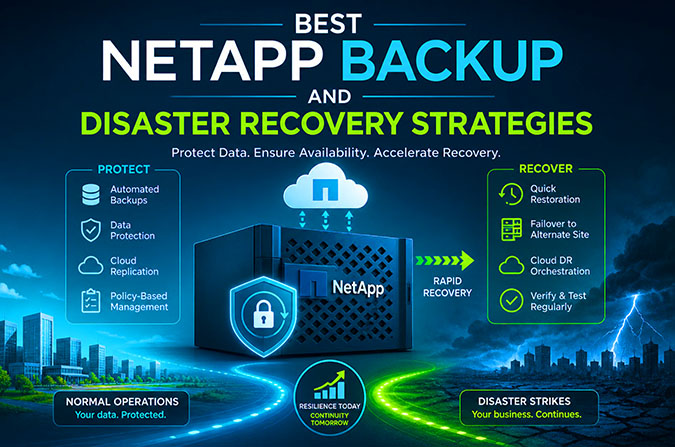
Understanding the Importance of Backup and Disaster Recovery
Before diving into specific strategies, it’s important to distinguish between backup and disaster recovery:
- Backup involves creating copies of data to restore it in case of loss or corruption.
- Disaster Recovery focuses on restoring entire systems, applications, and operations after a catastrophic event.
A comprehensive strategy combines both elements to minimize downtime and data loss.
NetApp provides a suite of tools that integrate storage, replication, and cloud capabilities, making it easier to build a unified data protection framework.
1. Implement the 3-2-1 Backup Rule
One of the most reliable approaches is the 3-2-1 backup strategy:
- Keep 3 copies of your data
- Store them on 2 different media types
- Maintain 1 copy offsite
With NetApp solutions, you can automate this approach using:
- On-premises storage systems
- Cloud backups via NetApp Cloud Volumes
- Replication to remote data centers
This ensures redundancy and protects against hardware failure, cyberattacks, and natural disasters.
2. Use Snapshot Technology for Instant Recovery
NetApp’s Snapshot technology is a cornerstone of its backup strategy. Snapshots are:
- Space-efficient
- Near-instantaneous
- Non-disruptive
They allow you to capture the state of your data at a specific point in time without affecting performance.
Benefits of Snapshots:
- Rapid recovery from accidental deletion
- Protection against ransomware
- Minimal storage overhead
By scheduling frequent snapshots, businesses can significantly reduce Recovery Point Objective (RPO), ensuring minimal data loss.
3. Leverage SnapMirror for Data Replication
Replication is essential for disaster recovery, and NetApp’s SnapMirror technology enables efficient data transfer between systems.
Key Features:
- Asynchronous and synchronous replication
- Incremental updates (only changed data is transferred)
- Support for hybrid cloud environments
SnapMirror allows organizations to replicate data to:
- Secondary on-premises systems
- Remote data centers
- Public cloud platforms
In case of a disaster, workloads can be quickly switched to the replicated environment, minimizing downtime.
4. Adopt a Hybrid Cloud Backup Strategy
Modern businesses are increasingly adopting hybrid cloud models, and NetApp excels in this area.
Why Hybrid Cloud?
- Scalability
- Cost efficiency
- Geographic redundancy
NetApp integrates seamlessly with major cloud providers, enabling:
- Automated backups to the cloud
- Long-term archival storage
- Disaster recovery as a service (DRaaS)
This approach ensures that even if your primary data center is compromised, your data remains सुरक्षित and accessible in the cloud.
5. Automate Backup and Recovery Processes
Manual backup processes are prone to errors and inefficiencies. Automation is key to ensuring consistency and reliability.
NetApp offers tools that allow you to:
- Schedule backups
- Monitor system health
- Trigger automated failover
Advantages of Automation:
- Reduced human error
- Faster recovery times
- Improved compliance with data protection policies
Automation also enables IT teams to focus on strategic initiatives rather than routine maintenance.
6. Test Your Disaster Recovery Plan Regularly
A backup strategy is only as good as its ability to perform under pressure. Regular testing is essential.
Best Practices:
- Conduct DR drills at least twice a year
- Simulate different disaster scenarios
- Validate recovery times and data integrity
NetApp solutions allow non-disruptive testing, meaning you can verify your DR plan without impacting production systems.
7. Protect Against Ransomware and Cyber Threats
Cybersecurity is a major concern, and backup systems are often targeted by attackers.
NetApp provides built-in security features such as:
- Immutable snapshots
- Multi-factor authentication
- Encryption at rest and in transit
Ransomware Protection Strategy:
- Use frequent snapshots
- Store backups in isolated environments
- Monitor for unusual activity
With these measures, even if your primary data is compromised, you can restore clean versions quickly.
8. Optimize Storage Efficiency
Efficient storage management is critical for cost-effective backup solutions.
NetApp offers advanced features like:
- Deduplication
- Compression
- Tiering
These technologies reduce the amount of storage required, allowing you to maintain multiple backup copies without excessive costs.
9. Define Clear RPO and RTO Objectives
Every organization should define:
- Recovery Point Objective (RPO): Maximum acceptable data loss
- Recovery Time Objective (RTO): Maximum acceptable downtime
NetApp tools enable you to align your backup and DR strategy with these objectives.
Example:
- Critical applications: Low RPO and RTO (near real-time recovery)
- Less critical data: Higher RPO and RTO
This prioritization ensures efficient resource allocation and faster recovery for mission-critical systems.
10. Centralize Data Management
Managing multiple backup systems can be complex. NetApp provides centralized management platforms that allow you to:
- Monitor all backups from a single dashboard
- Manage policies across environments
- Analyze performance and usage
Centralization improves visibility and simplifies administration, especially in large enterprises.
11. Ensure Compliance and Data Governance
Many industries have strict data protection regulations. A strong backup strategy must support compliance requirements.
NetApp solutions help with:
- Audit trails
- Data retention policies
- Secure access controls
This ensures that your organization meets legal and regulatory standards while protecting sensitive information.
12. Plan for Scalability
As your business grows, your data volume will increase. Your backup and DR strategy must scale accordingly.
NetApp’s flexible architecture allows you to:
- Expand storage capacity بسهولة
- Integrate new technologies
- Support evolving workloads
Scalability ensures that your data protection strategy remains effective over time.
Conclusion
Building a reliable backup and disaster recovery strategy is essential for any organization that values its data. By leveraging the powerful tools and technologies offered by NetApp, businesses can create a resilient infrastructure that minimizes risk and ensures continuity.
From implementing the 3-2-1 backup rule to leveraging hybrid cloud solutions and automation, the strategies outlined in this article provide a comprehensive framework for data protection. Regular testing, strong security measures, and clear recovery objectives further enhance your ability to respond effectively to any disruption.
In an era where data is the backbone of operations, investing in a robust NetApp backup and disaster recovery strategy is not just a technical decision—it’s a business imperative.