How NetApp Helps Businesses Reduce Hybrid Cloud Costs
Hybrid cloud environments have become the preferred infrastructure model for modern enterprises. Organizations want the flexibility of public cloud services while maintaining the control and security of private infrastructure. However, managing a hybrid cloud ecosystem often creates unexpected operational expenses, storage inefficiencies, and data management challenges. Businesses frequently discover that cloud migration alone does not automatically reduce IT spending.
This is where NetApp plays a critical role. By offering intelligent data management, optimized storage solutions, automation tools, and cloud integration technologies, NetApp helps businesses lower hybrid cloud costs without sacrificing performance or scalability.
In today’s highly competitive digital landscape, reducing infrastructure expenses while maintaining operational efficiency is essential. NetApp provides organizations with a smarter way to manage data across on-premises systems and public cloud platforms such as Amazon Web Services, Microsoft Azure, and Google Cloud.
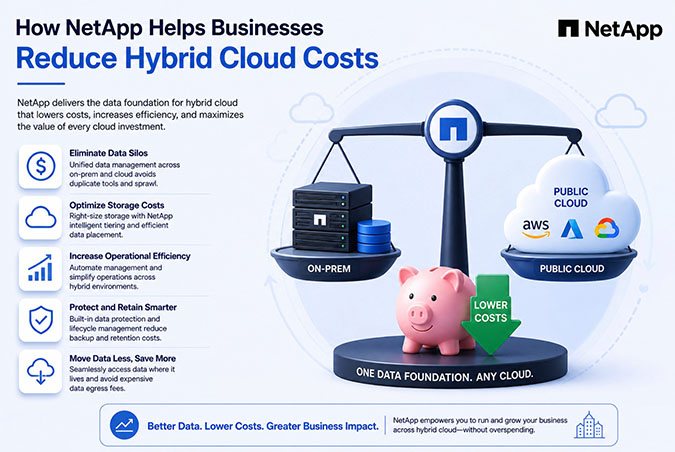
Understanding Hybrid Cloud Cost Challenges
Many organizations adopt hybrid cloud strategies expecting improved flexibility and lower operational expenses. While hybrid cloud delivers many advantages, it can also introduce hidden costs, including:
- Overprovisioned storage
- Unused cloud resources
- High data transfer fees
- Complex management systems
- Expensive backup and disaster recovery processes
- Increased administrative overhead
Without proper optimization, companies may end up paying more than expected for cloud storage and computing resources. Businesses also face difficulties maintaining consistent visibility across multiple environments.
NetApp addresses these problems through intelligent storage management and unified data services that simplify hybrid cloud operations.
Unified Data Management Across Environments
One of the biggest advantages of NetApp solutions is the ability to manage data consistently across private and public cloud platforms. Many enterprises struggle because their cloud and on-premises infrastructures operate separately, leading to duplicated resources and inefficient workflows.
NetApp’s unified approach allows businesses to:
- Move workloads seamlessly between environments
- Reduce duplicate data copies
- Improve storage utilization
- Simplify administrative tasks
- Lower operational complexity
Instead of maintaining separate management systems for every cloud platform, organizations can centralize operations through NetApp’s integrated tools. This reduces labor costs and minimizes the risk of configuration errors that could increase expenses.
Storage Efficiency Technologies
Storage costs represent one of the largest expenses in hybrid cloud environments. NetApp helps organizations reduce these costs through advanced storage efficiency technologies.
Data Deduplication
Deduplication eliminates redundant copies of data, allowing businesses to store more information using less physical capacity. In hybrid environments where multiple backups and replicated datasets exist, deduplication can significantly reduce storage requirements.
This means companies spend less on both on-premises hardware and cloud storage subscriptions.
Data Compression
Compression technologies reduce file sizes without affecting usability. Smaller datasets consume less bandwidth during transfers and require less storage space overall.
Reduced storage consumption directly lowers cloud service costs.
Thin Provisioning
Thin provisioning allows businesses to allocate storage dynamically instead of reserving large unused blocks of capacity. Organizations only consume storage resources when needed, avoiding unnecessary infrastructure expenses.
This approach improves resource efficiency while supporting future scalability.
Optimized Cloud Tiering
Not all data needs high-performance storage. Many businesses waste money storing inactive or rarely accessed files on expensive primary storage systems.
NetApp solves this issue with intelligent cloud tiering solutions. Frequently used data remains on high-performance infrastructure, while inactive data automatically moves to lower-cost cloud storage tiers.
This optimization provides several benefits:
- Reduced primary storage costs
- Lower cloud infrastructure expenses
- Improved storage performance
- Better utilization of premium resources
Businesses can maintain fast access to critical workloads while minimizing costs associated with archival and inactive datasets.
Reduced Data Transfer Expenses
Data transfer fees are often overlooked during hybrid cloud planning. Moving large amounts of information between cloud providers and on-premises infrastructure can generate substantial charges.
NetApp minimizes these expenses by optimizing data movement and reducing unnecessary transfers. Its replication technologies transfer only changed data blocks instead of entire datasets, dramatically lowering bandwidth usage.
Efficient replication helps businesses:
- Reduce network costs
- Accelerate backup operations
- Improve disaster recovery performance
- Lower cloud egress fees
These savings become increasingly important for enterprises managing petabytes of information across multiple environments.
Simplified Backup and Disaster Recovery
Traditional backup systems are often expensive, complex, and resource-intensive. Hybrid cloud environments require scalable disaster recovery solutions that can protect data without increasing infrastructure costs.
NetApp provides efficient backup and recovery services that help businesses reduce expenses while improving resilience.
Snapshot Technology
NetApp Snapshot technology creates near-instant backups without consuming excessive storage space. Unlike traditional backup methods, snapshots capture only incremental changes.
Benefits include:
- Faster recovery times
- Lower storage consumption
- Reduced backup infrastructure costs
- Minimal performance impact
Organizations can protect mission-critical applications without maintaining large secondary storage environments.
Cloud-Based Disaster Recovery
NetApp enables businesses to use public cloud platforms for disaster recovery instead of investing heavily in secondary physical data centers.
This reduces:
- Hardware expenses
- Maintenance costs
- Power consumption
- Data center operational overhead
Cloud-based recovery models provide enterprise-grade resilience at a fraction of traditional disaster recovery costs.
Automation and Operational Efficiency
Manual infrastructure management increases labor costs and introduces operational inefficiencies. IT teams often spend significant time provisioning storage, managing backups, and monitoring cloud resources.
NetApp automates many of these processes through intelligent orchestration and policy-based management.
Automation benefits include:
- Reduced administrative workload
- Faster deployment times
- Fewer human errors
- Improved resource optimization
- Lower operational expenses
By automating repetitive tasks, organizations can focus IT resources on innovation rather than maintenance.
Improved Visibility and Cost Control
A major challenge in hybrid cloud management is tracking spending across multiple platforms. Businesses often struggle to understand which workloads consume the most resources.
NetApp provides centralized visibility into storage usage, cloud consumption, and infrastructure performance.
With enhanced analytics, companies can:
- Identify underutilized resources
- Optimize workload placement
- Forecast future capacity needs
- Eliminate wasteful spending
- Improve budgeting accuracy
Better visibility enables proactive cost management and prevents unexpected cloud billing increases.
Flexibility Without Vendor Lock-In
Vendor lock-in can significantly increase long-term cloud expenses. Businesses that rely too heavily on a single cloud provider may face limited pricing flexibility and higher migration costs.
NetApp supports multi-cloud strategies, allowing organizations to operate across different cloud providers while maintaining consistent data management practices.
This flexibility helps businesses:
- Choose cost-effective cloud services
- Avoid dependence on one vendor
- Negotiate better pricing
- Optimize workload distribution
A multi-cloud approach creates greater financial control and operational agility.
Scalability for Growing Businesses
As organizations grow, infrastructure requirements increase rapidly. Traditional storage expansion often requires expensive hardware investments and lengthy deployment cycles.
NetApp enables scalable hybrid cloud growth through flexible storage architectures and cloud-native integration.
Businesses can:
- Expand storage on demand
- Scale workloads efficiently
- Avoid overbuilding infrastructure
- Pay only for required resources
This elasticity prevents unnecessary capital expenditures while supporting future business expansion.
Sustainability and Energy Savings
Reducing infrastructure costs also involves lowering energy consumption and improving operational sustainability.
NetApp’s efficient storage technologies help organizations reduce:
- Power usage
- Cooling requirements
- Physical hardware footprint
- Data center space needs
Smaller, more efficient storage environments contribute to both environmental sustainability and long-term cost reduction.
Many enterprises now prioritize energy-efficient IT operations as part of broader ESG initiatives. NetApp supports these goals while helping businesses reduce operational spending.
Supporting Digital Transformation
Modern businesses require infrastructure that supports innovation, remote work, analytics, and AI-driven applications. However, digital transformation projects can become expensive without efficient data management.
NetApp helps organizations modernize infrastructure while maintaining cost control. Its solutions support:
- Cloud-native applications
- AI and machine learning workloads
- Enterprise databases
- Virtual desktop environments
- DevOps automation
By optimizing data management across environments, NetApp enables businesses to innovate faster without overspending on infrastructure.
Why Businesses Choose NetApp
Organizations across industries choose NetApp because it combines performance, flexibility, and cost efficiency in a unified platform.
Key reasons include:
- Strong hybrid cloud integration
- Advanced storage optimization
- Multi-cloud compatibility
- Simplified management
- Reliable data protection
- Scalable infrastructure solutions
Businesses can reduce operational complexity while improving performance and maintaining strong security standards.
Final Thoughts
Hybrid cloud adoption continues to grow as organizations seek greater flexibility and scalability. However, controlling hybrid cloud costs requires more than simply migrating workloads to the cloud.
NetApp helps businesses optimize storage, automate operations, reduce data transfer expenses, and improve visibility across complex environments. Through intelligent data management and cloud integration technologies, companies can significantly lower operational costs while maintaining high performance and reliability.
As cloud environments become more sophisticated, businesses need solutions that deliver efficiency, scalability, and financial control. NetApp provides a comprehensive approach that enables enterprises to maximize the value of their hybrid cloud investments while reducing unnecessary expenses.