As enterprises shift from traditional monikers to microservices-based architectures, Kubernetes has emerged as the definitive orchestration standard for containerized applications. While Kubernetes excels at managing stateless components like web front-ends, scaling stateful workloads—such as transactional databases, AI/ML pipelines, and analytics platforms—presents significant storage and data management hurdles.
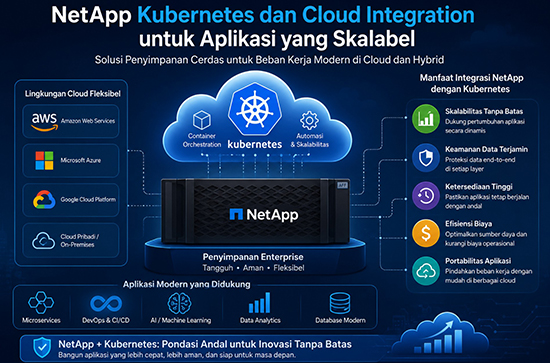
Without enterprise-grade storage integration, containerized applications risk encountering data loss, dynamic provisioning bottlenecks, and inconsistent performance. NetApp addresses these exact challenges by bridging high-performance enterprise storage with cloud-native Kubernetes ecosystems. Through orchestration drivers like Astra Trident, governance frameworks like Astra Control, and multi-cloud integration services, NetApp delivers a unified hybrid cloud platform for scalable stateful workloads.
1. The Challenge of Stateful Workloads in Cloud-Native Kubernetes
Kubernetes was originally architected for ephemeral workloads where individual instances could fail without affecting overall state. Managing stateful data introduces distinct operational complexities across three major areas:
-
Dynamic Provisioning Gaps: Standard container storage interfaces often lack the speed and agility required to provision, resize, or clean up persistent volumes at scale automatically.
-
Multicloud Data Mobility: Applications frequently need to migrate between on-premises data centers and public clouds (e.g., AWS, Azure, Google Cloud Platform) without re-architecting underlying storage architectures.
-
Enterprise Data Protection: Standard Kubernetes backups rarely account for application-level consistency, risking database corruption during point-in-time recovery or disaster events.
Solving these challenges requires a storage layer that speaks native Kubernetes commands while delivering low-latency performance, high availability, and instant snapshotting.
2. Core Components of NetApp’s Kubernetes Ecosystem
NetApp’s cloud-native stack integrates storage engines with the Kubernetes Control Plane using open-source drivers and enterprise data management tools.
NetApp Astra Trident: The Storage Orchestrator
Astra Trident is an open-source, Container Storage Interface (CSI)-compliant dynamic storage orchestrator. Trident runs natively within the Kubernetes cluster as a Controller Pod and per-node Node Pods, monitoring API requests for Persistent Volume Claims (PVCs). When a application requests storage, Trident dynamically provisions volumes from specified storage backends—including on-premises NetApp ONTAP systems and first-party public cloud file services.
  +-------------------------------------------------------------+
  |                   Kubernetes Control Plane                  |
  +-------------------------------------------------------------+
                                 |
                     (PersistentVolumeClaims)
                                 v
  +-------------------------------------------------------------+
  |                     NetApp Astra Trident                    |
  |                (CSI Storage Orchestrator)                   |
  +-------------------------------------------------------------+
               /                 |                 \
              /                  |                  \
             v                   v                   v
  +-------------------+ +-------------------+ +-------------------+
  | On-Premises ONTAP | |  Amazon FSx for   | |  Azure NetApp     |
  | (AFF / FAS / SAN) | | NetApp ONTAP (AWS)| |   Files (Azure)   |
  +-------------------+ +-------------------+ +-------------------+
NetApp Astra Control: Application-Aware Lifecycle Management
While Trident manages lower-level volume allocation, Astra Control operates at the application tier. It provides application-aware data management, capturing not just persistent storage, but also associated Kubernetes manifests, ConfigMaps, Secrets, and state metadata. Available as both a fully managed cloud service (Astra Control Service) and a self-managed software package (Astra Control Center), it handles automated backups, cross-cluster migrations, and instant application cloning.
3. Seamless Cloud Integration Across Major Providers
One of NetApp’s core advantages is its integration into native public cloud infrastructure. Rather than running abstracted software layers that degrade performance, NetApp’s ONTAP storage engine runs as a native file service within top cloud providers.
Public Cloud Integrations
| Cloud Provider | NetApp Integration Service | Primary Use Cases | Key Benefits |
| AWS | Amazon FSx for NetApp ONTAP | High-performance DBs, EKS clusters, dev/test cloning | Native AWS console integration, NVMe-over-Fabrics speeds, automated tiering |
| Microsoft Azure | Azure NetApp Files (ANF) | SAP HANA on AKS, enterprise file shares, stateful microservices | Sub-millisecond latencies, native Azure Resource Manager integration |
| Google Cloud | Google Cloud NetApp Volumes | GKE stateful sets, AI training data repositories | Integrated GCP billing, instant volume snapshots, scalable NAS storage |
By leveraging these native cloud integrations alongside on-premises ONTAP arrays, organizations achieve true hybrid multi-cloud portability. Applications can be developed on-premises using OpenShift or Anthos, backed up to object storage, and restored directly into Amazon EKS or Azure AKS without converting data formats.
4. Key Architectural Benefits for Scalable Applications
High-Speed Dynamic Storage Provisioning
Traditional SAN or NAS allocation requires manual intervention from storage administrators. NetApp Trident automates this workflow entirely via Kubernetes StorageClasses. Application developers specify volume characteristics—such as protocol (NFS or iSCSI), performance tier, and encryption parameters—directly in standard Kubernetes YAML manifests. Trident translates these requirements instantly into storage volumes.
YAML
apiVersion: storage.k8s.io/v1
kind: StorageClass
metadata:
name: netapp-ontap-nas-fast
provisioner: csi.trident.netapp.io
parameters:
backendType: "ontap-nas"
media: "ssd"
provisioningType: "thin"
Application-Consistent Disaster Recovery and Snapshots
Standard block storage snapshots taken at arbitrary intervals risk capturing partial writes, potentially causing database corruption. NetApp Astra Control solves this through application-aware hooks that temporarily quiesce database operations, trigger space-efficient NetApp Snapshot copies, and resume traffic in milliseconds. Combined with SnapMirror replication technology, enterprise teams can achieve near-zero Recovery Point Objectives (RPO) and low Recovery Time Objectives (RTO) across clusters and geographic regions.
Efficient Space and Cost Management
Stateful containers in dev/test or CI/CD pipelines consume vast amounts of storage when environments are replicated. NetApp’s cloud integration brings enterprise efficiency capabilities directly to containerized workflows:
-
FlexClone Technology: Allows developers to instantly clone terabyte-scale databases into isolated test environments in seconds, using almost zero initial storage capacity.
-
Inline Deduplication and Compression: Shrinks data footprints prior to writing to disk, reducing operational expenses across cloud environments.
-
Automated Data Tiering: Inactive container persistent volume data automatically tiers down to low-cost object storage (e.g., Amazon S3 or Azure Blob) while active data remains on high-performance NVMe/SSD media.
5. Enterprise Implementation Best Practices
To maximize performance, security, and uptime when deploying NetApp storage for Kubernetes workloads, consider the following strategic guidelines:
-
Design Modular StorageClasses: Define StorageClasses based on SLA tiers (e.g.,
gold-nvme,silver-nas,archive-object) rather than storage vendor models. This abstracts infrastructure details away from developers. -
Enforce Storage ResourceQuotas: Use standard Kubernetes
ResourceQuotaobjects to cap volume allocations per namespace, preventing rogue microservices from exhausting backend storage capacity. -
Isolate Network Traffic: Segregate storage traffic (iSCSI, NFS) onto dedicated virtual interfaces or VLANs to guarantee sustained IOPS and protect data against cross-network sniffing.
-
Implement Automated Lifecycle Policy via Astra Control: Automate periodic, application-consistent backups to off-site target buckets to ensure continuous protection against ransomware or cluster-level failures.
Conclusion
Scaling stateful Kubernetes applications across hybrid and multi-cloud environments requires an underlying storage ecosystem that matches the speed and agility of containers. By pairing Kubernetes with NetApp’s integration stack—anchored by Astra Trident, Astra Control, and native cloud services like Amazon FSx for NetApp ONTAP and Azure NetApp Files—enterprises bridge the gap between cloud-native speed and enterprise data management. The result is a resilient, portable, and performant storage foundation capable of scaling mission-critical workloads seamlessly from on-premises data centers to any cloud.