NetApp Cloud Volumes Explained for High-Performance Workloads
Modern businesses generate and process enormous amounts of data every day. From artificial intelligence and machine learning to video rendering, enterprise databases, and analytics platforms, organizations require storage systems that can keep up with increasingly demanding workloads. Traditional on-premises storage infrastructure often struggles to provide the flexibility, scalability, and performance needed in today’s cloud-first environment. This is where NetApp Cloud Volumes enters the picture.
NetApp Cloud Volumes is a cloud-native storage service designed to deliver enterprise-grade performance, scalability, and data management capabilities for modern applications and workloads. It combines the reliability of enterprise storage with the agility of public cloud platforms, helping organizations run high-performance workloads efficiently across hybrid and multi-cloud environments.
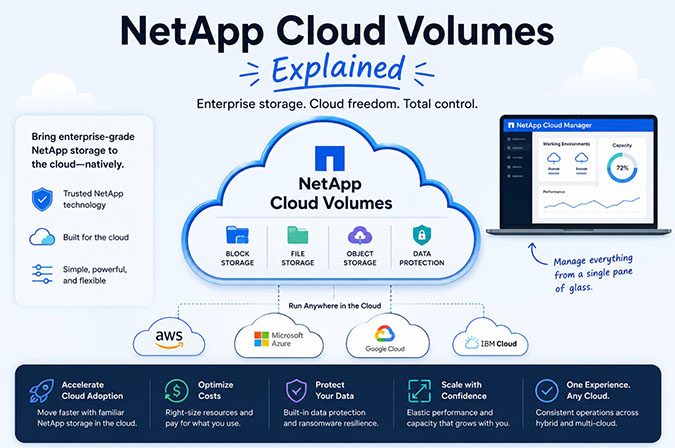
Understanding NetApp Cloud Volumes
NetApp Cloud Volumes is a fully managed cloud storage solution that provides high-performance file and block storage services for enterprise applications. It integrates with major cloud providers such as Amazon Web Services, Microsoft Azure, and Google Cloud Platform.
The platform is built to support workloads that require low latency, high throughput, and rapid scalability. Unlike traditional storage systems that require extensive hardware management, Cloud Volumes allows businesses to deploy and manage storage resources directly from the cloud with minimal operational complexity.
Organizations can use NetApp Cloud Volumes for a wide range of use cases, including:
- Enterprise databases
- High-performance computing (HPC)
- AI and machine learning
- Media rendering and streaming
- Big data analytics
- DevOps and containerized applications
- Disaster recovery and backup solutions
Its ability to provide consistent performance across multiple cloud environments makes it particularly valuable for enterprises adopting hybrid cloud strategies.
Key Features of NetApp Cloud Volumes
High Performance and Low Latency
One of the primary advantages of NetApp Cloud Volumes is its ability to handle high-performance workloads with low latency. Many enterprise applications, especially databases and AI platforms, depend on rapid data access to maintain operational efficiency.
Cloud Volumes uses optimized storage architectures that support:
- High input/output operations per second (IOPS)
- Fast read and write speeds
- Predictable workload performance
- Low-latency access for mission-critical applications
This performance level is essential for industries such as finance, healthcare, media production, and scientific research, where delays in data processing can significantly impact business operations.
Elastic Scalability
Traditional storage systems often require businesses to predict future storage needs and invest heavily in infrastructure upfront. NetApp Cloud Volumes removes this limitation by offering elastic scalability.
Organizations can dynamically scale storage capacity and performance up or down based on workload requirements. This flexibility helps businesses avoid overprovisioning while ensuring applications always have the resources they need.
For example, a company running seasonal analytics workloads can increase storage performance during peak demand and reduce it afterward, optimizing operational costs without sacrificing efficiency.
Multi-Cloud Integration
Many enterprises operate across multiple cloud providers to improve resilience, avoid vendor lock-in, and optimize costs. NetApp Cloud Volumes supports multi-cloud deployments, enabling seamless data management across different environments.
This capability allows organizations to:
- Move workloads between cloud providers
- Replicate data across regions
- Maintain consistent storage policies
- Simplify hybrid cloud management
By providing a unified storage experience, NetApp helps businesses reduce complexity while improving operational agility.
Advanced Data Protection
Data protection is a critical concern for enterprises handling sensitive information and business-critical applications. NetApp Cloud Volumes includes advanced data protection features such as:
- Automated snapshots
- Backup and recovery
- Replication services
- Disaster recovery capabilities
- Data encryption
These features help organizations minimize downtime and protect against accidental deletion, ransomware attacks, and system failures.
Snapshots are especially valuable because they allow rapid recovery of files and applications without lengthy restoration processes.
Why High-Performance Workloads Need Specialized Storage
High-performance workloads generate massive amounts of data and require rapid processing capabilities. Standard cloud storage solutions may not deliver the performance consistency required for these demanding applications.
For example:
- AI models require fast access to training datasets.
- Financial trading systems need ultra-low latency.
- Video production teams require high-throughput rendering pipelines.
- Enterprise databases demand predictable response times.
NetApp Cloud Volumes addresses these challenges by combining enterprise storage technologies with cloud-native infrastructure.
Unlike generic storage services, Cloud Volumes is engineered specifically for performance-intensive environments. This specialized approach ensures workloads can operate efficiently even under heavy demand.
NetApp Cloud Volumes for AI and Machine Learning
Artificial intelligence and machine learning workloads place enormous pressure on storage systems due to the large datasets involved in training and inference processes.
AI pipelines require storage that can:
- Handle parallel data access
- Deliver consistent throughput
- Support GPU-intensive processing
- Scale rapidly as datasets grow
NetApp Cloud Volumes supports these requirements by providing high-speed data access and scalable storage architectures.
Data scientists and machine learning engineers benefit from faster model training times, improved collaboration, and simplified data management. Since many AI projects rely on hybrid or multi-cloud infrastructures, NetApp’s cloud integration capabilities become especially valuable.
Organizations can store large training datasets in the cloud while maintaining performance levels comparable to on-premises enterprise storage systems.
Enterprise Database Performance
Enterprise databases are among the most demanding workloads in modern IT environments. Applications such as customer relationship management systems, enterprise resource planning platforms, and transactional databases require reliable low-latency storage.
NetApp Cloud Volumes helps optimize database performance by providing:
- High IOPS capabilities
- Fast transaction processing
- Consistent throughput
- Reliable replication and backup
Databases running on platforms like Oracle, SAP, and Microsoft SQL Server can benefit from improved responsiveness and reduced infrastructure management overhead.
This enables IT teams to focus more on application optimization and business growth rather than storage administration.
Benefits for Media and Entertainment
The media and entertainment industry relies heavily on high-throughput storage systems for video editing, rendering, animation, and content delivery.
Modern production environments generate terabytes of data from high-resolution video formats such as 4K and 8K. These workflows require storage systems capable of handling massive data streams without bottlenecks.
NetApp Cloud Volumes provides the bandwidth and scalability necessary for collaborative media workflows. Production teams can access files quickly, share assets across distributed teams, and accelerate rendering tasks.
Cloud-based workflows also allow studios to scale resources during intensive production periods while reducing infrastructure costs during downtime.
Simplified Management and Automation
Managing enterprise storage infrastructure traditionally requires specialized expertise and extensive maintenance. NetApp Cloud Volumes simplifies operations through centralized management and automation tools.
Administrators can:
- Provision storage quickly
- Monitor performance metrics
- Automate backups
- Configure replication policies
- Scale workloads dynamically
Automation reduces manual errors and improves operational efficiency. Integration with cloud-native management platforms also enables businesses to streamline DevOps workflows and infrastructure deployment.
This operational simplicity is especially important for organizations undergoing digital transformation initiatives.
Cost Efficiency and Resource Optimization
While high-performance storage systems are often associated with significant costs, NetApp Cloud Volumes helps organizations optimize spending through flexible consumption models.
Businesses only pay for the storage resources they use, allowing them to align infrastructure costs with actual demand. Features such as tiering and automated scaling further improve cost efficiency.
In addition, cloud-native deployment reduces the need for expensive on-premises hardware purchases, maintenance contracts, and data center operations.
This makes enterprise-grade storage more accessible to organizations of all sizes.
The Future of Cloud-Based Enterprise Storage
As organizations continue adopting cloud-first strategies, demand for high-performance cloud storage solutions will continue growing. Emerging technologies such as AI, edge computing, real-time analytics, and advanced automation will place even greater pressure on storage infrastructure.
NetApp Cloud Volumes is positioned to meet these evolving demands by combining enterprise reliability with cloud scalability and flexibility.
Businesses increasingly require storage solutions that can support distributed applications, global collaboration, and data-intensive workloads without sacrificing performance or security. NetApp’s continued investment in cloud innovation ensures organizations can adapt to changing technological requirements.
Conclusion
NetApp Cloud Volumes provides a powerful solution for organizations running high-performance workloads in modern cloud environments. Its combination of low latency, scalability, multi-cloud integration, and advanced data protection makes it well-suited for enterprise applications, AI systems, databases, and media workflows.
By eliminating many of the limitations associated with traditional storage infrastructure, NetApp enables businesses to focus on innovation, operational efficiency, and digital transformation. As data demands continue increasing across industries, cloud-native storage platforms like NetApp Cloud Volumes will play a central role in supporting the next generation of enterprise computing.