NetApp Cloud Storage Solutions for Enterprise Data Management
Modern enterprises generate massive volumes of data every day. From customer transactions and business analytics to remote collaboration and artificial intelligence workloads, organizations rely on secure and scalable storage systems to manage critical information efficiently. As digital transformation accelerates, businesses increasingly need cloud-based infrastructure that delivers flexibility, high performance, advanced security, and cost efficiency. This is where NetApp cloud storage solutions play a significant role in enterprise data management.
NetApp has established itself as a leading provider of intelligent data infrastructure and cloud storage technologies. Its solutions help organizations simplify data operations across hybrid and multi-cloud environments while improving performance, reducing operational complexity, and supporting business continuity. Enterprises across industries use NetApp to optimize storage management, improve application performance, and protect valuable digital assets.
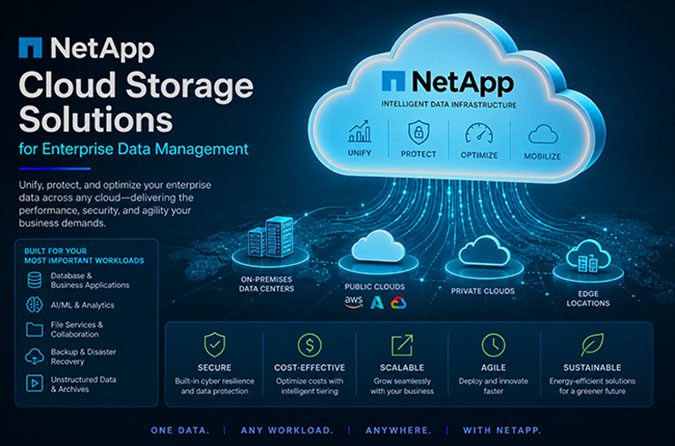
Understanding Enterprise Data Management
Enterprise data management refers to the process of collecting, organizing, storing, protecting, and analyzing business data throughout its lifecycle. Effective data management allows companies to make informed decisions, improve operational efficiency, and maintain regulatory compliance.
However, enterprise data environments are becoming increasingly complex. Businesses often store data across on-premises servers, private clouds, and public cloud platforms such as Amazon Web Services (AWS), Microsoft Azure, and Google Cloud. Managing data across multiple environments can create challenges related to security, scalability, performance, and cost control.
Organizations also face growing demands for:
- Faster data access and application performance
- Reliable backup and disaster recovery systems
- Enhanced cybersecurity protection
- Simplified storage administration
- Compliance with data privacy regulations
- Scalable infrastructure for future growth
NetApp cloud storage solutions address these challenges by delivering integrated data management capabilities designed for modern enterprise workloads.
What Makes NetApp Cloud Storage Solutions Different?
NetApp focuses on intelligent data management rather than simply providing storage hardware. The company combines cloud-native technologies, automation, AI-driven insights, and hybrid cloud integration to create flexible enterprise storage environments.
One of the major strengths of NetApp is its ability to provide a consistent data management experience across different cloud providers and on-premises infrastructure. This helps enterprises avoid vendor lock-in while maintaining centralized visibility and control.
NetApp solutions are designed to support:
- Hybrid cloud infrastructure
- Multi-cloud data operations
- High-performance applications
- Enterprise-grade security
- Data backup and disaster recovery
- AI and machine learning workloads
- DevOps and containerized environments
This broad functionality makes NetApp a valuable platform for businesses seeking scalable and future-ready cloud storage solutions.
Hybrid Cloud Storage Capabilities
Hybrid cloud architecture has become a preferred strategy for many enterprises because it combines the flexibility of public cloud services with the control of private infrastructure. NetApp excels in hybrid cloud environments by enabling seamless movement of data between on-premises systems and cloud platforms.
With NetApp cloud storage solutions, enterprises can:
- Replicate data across environments
- Scale storage resources dynamically
- Migrate workloads with minimal disruption
- Optimize storage costs
- Improve application availability
This flexibility allows businesses to keep sensitive workloads in private environments while leveraging the scalability of public clouds for analytics, backup, or disaster recovery.
NetApp’s integration with major cloud providers also simplifies enterprise adoption. Organizations can manage storage resources consistently whether applications are running locally or in the cloud.
Multi-Cloud Data Management
Many enterprises use multiple cloud providers to avoid dependence on a single vendor and improve resilience. However, managing data across multiple platforms can become operationally difficult.
NetApp simplifies multi-cloud management by providing centralized tools for monitoring, automation, and data orchestration. Enterprises can move workloads between clouds based on pricing, performance requirements, or geographic considerations.
This multi-cloud flexibility offers several benefits:
Improved Business Continuity
Data replication across cloud environments improves redundancy and minimizes downtime during service disruptions.
Cost Optimization
Businesses can place workloads in the most cost-effective cloud environment without sacrificing performance.
Better Performance
Applications can operate closer to end users or processing resources, reducing latency.
Regulatory Compliance
Organizations can store data in specific regions to meet compliance and data sovereignty requirements.
NetApp’s multi-cloud capabilities help enterprises maintain agility while simplifying complex storage environments.
Advanced Data Security and Ransomware Protection
Cybersecurity threats continue to increase worldwide, and ransomware attacks remain one of the biggest concerns for enterprise IT teams. Protecting critical business data requires multiple layers of security and proactive threat detection.
NetApp cloud storage solutions include advanced security features designed to safeguard enterprise data against unauthorized access, corruption, and cyberattacks.
Key security capabilities include:
- Encryption for data at rest and in transit
- Multi-factor authentication support
- Role-based access control
- Snapshot technology for rapid recovery
- Immutable backups
- AI-driven ransomware detection
NetApp snapshot technology is especially valuable because it allows businesses to restore data quickly after accidental deletion or ransomware incidents. Immutable snapshots prevent attackers from modifying backup copies, improving recovery reliability.
In addition, NetApp integrates with enterprise cybersecurity frameworks and cloud security tools, helping organizations strengthen overall data protection strategies.
Scalability for Growing Enterprises
As organizations grow, storage requirements expand rapidly. Traditional infrastructure often struggles to scale efficiently without large capital investments.
NetApp cloud storage solutions provide elastic scalability that allows enterprises to increase storage capacity on demand. Businesses can scale resources up or down based on changing workloads without major hardware upgrades.
This scalability is particularly important for:
- Big data analytics
- Artificial intelligence applications
- Video processing
- Remote collaboration systems
- Database management
- E-commerce platforms
By supporting flexible scaling, NetApp helps organizations avoid overprovisioning while maintaining optimal application performance.
Data Backup and Disaster Recovery
Reliable backup and disaster recovery systems are essential for minimizing downtime and protecting business operations. Hardware failures, natural disasters, cyberattacks, and human errors can all lead to critical data loss.
NetApp offers integrated backup and disaster recovery solutions that help enterprises maintain business continuity. Automated replication and backup scheduling simplify data protection while reducing administrative overhead.
Benefits of NetApp disaster recovery solutions include:
- Faster recovery times
- Reduced downtime
- Automated failover capabilities
- Cross-region data replication
- Cloud-based backup storage
- Simplified recovery testing
These capabilities allow businesses to recover operations quickly after disruptions while maintaining customer trust and operational stability.
Performance Optimization for Enterprise Workloads
Modern enterprise applications require high-speed data access and consistent performance. Slow storage infrastructure can negatively affect productivity, customer experience, and business operations.
NetApp cloud storage solutions are optimized for high-performance workloads such as:
- Enterprise databases
- Virtual desktop infrastructure (VDI)
- Machine learning systems
- ERP platforms
- Customer relationship management applications
- Real-time analytics
Technologies such as flash storage, intelligent caching, automated tiering, and workload balancing help improve application responsiveness.
NetApp also uses AI-powered analytics to identify performance bottlenecks and recommend optimization strategies. This proactive approach helps IT teams maintain reliable performance across complex enterprise environments.
Simplified Management Through Automation
Managing enterprise storage manually can consume significant time and resources. NetApp simplifies administration through automation and centralized management tools.
Automation capabilities help organizations:
- Reduce operational complexity
- Improve deployment speed
- Minimize human error
- Simplify resource allocation
- Enhance system monitoring
NetApp’s management platforms provide visibility into storage usage, system health, performance metrics, and security alerts from a single interface.
This centralized control improves efficiency for IT teams while allowing organizations to respond more quickly to changing business needs.
Supporting AI and Modern Workloads
Artificial intelligence and machine learning applications require fast, scalable, and reliable storage infrastructure. Large datasets must be processed efficiently to support training models and analytics workloads.
NetApp cloud storage solutions are designed to support AI-driven operations by providing:
- High-throughput storage performance
- Scalable data pipelines
- Efficient data movement
- Cloud-native integration
- Support for containerized applications
Enterprises can use NetApp infrastructure to accelerate AI development while maintaining consistent access to large volumes of structured and unstructured data.
The company also supports Kubernetes and container orchestration platforms, making it easier for DevOps teams to manage cloud-native applications.
Cost Efficiency and Resource Optimization
Controlling IT costs remains a major priority for enterprises adopting cloud infrastructure. Without proper management, cloud storage expenses can increase rapidly.
NetApp helps organizations optimize storage costs through:
- Automated tiering of inactive data
- Storage efficiency technologies
- Compression and deduplication
- Flexible consumption models
- Intelligent workload placement
These features reduce unnecessary storage usage while improving overall infrastructure efficiency.
By analyzing usage patterns and automating data placement, NetApp enables businesses to maximize return on investment while maintaining high service quality.
Industries Benefiting from NetApp Cloud Storage
NetApp cloud storage solutions support a wide range of industries, including:
Healthcare
Healthcare organizations use NetApp to manage electronic medical records, medical imaging, and compliance-sensitive patient data.
Financial Services
Banks and financial institutions rely on secure and high-performance storage for transaction processing, fraud detection, and regulatory compliance.
Retail and E-Commerce
Retail businesses use NetApp to support inventory systems, customer analytics, and online shopping platforms.
Manufacturing
Manufacturers leverage cloud storage for IoT data, supply chain analytics, and production optimization.
Media and Entertainment
Media companies manage large video files, digital assets, and collaborative editing workflows using scalable storage infrastructure.
The flexibility of NetApp solutions allows enterprises across industries to modernize their data environments efficiently.
The Future of Enterprise Cloud Storage
The future of enterprise storage will continue evolving as organizations adopt AI, edge computing, automation, and advanced analytics. Businesses increasingly need intelligent data infrastructure capable of supporting distributed workloads across multiple cloud environments.
NetApp continues investing in innovation to help enterprises adapt to these changes. Its focus on unified data management, automation, cybersecurity, and cloud integration positions the company as a major player in the future of enterprise storage.
As digital transformation accelerates, enterprises will require storage solutions that are not only scalable and secure but also intelligent and adaptable. NetApp cloud storage technologies provide the foundation for businesses seeking long-term efficiency, resilience, and operational agility.
Conclusion
NetApp cloud storage solutions offer enterprises a powerful platform for modern data management. By combining hybrid cloud flexibility, multi-cloud integration, advanced security, automation, and scalable performance, NetApp helps organizations manage growing data demands more effectively.
Businesses today face increasing challenges related to cybersecurity, scalability, compliance, and operational efficiency. NetApp addresses these challenges with intelligent storage infrastructure designed for modern enterprise environments.
From disaster recovery and ransomware protection to AI workload support and cost optimization, NetApp provides comprehensive capabilities that help organizations improve productivity and maintain business continuity.
For enterprises seeking reliable and future-ready cloud storage solutions, NetApp remains a trusted technology partner capable of supporting digital transformation initiatives across diverse industries.