Enterprise cloud computing has evolved from a simple infrastructure-as-a-service model into a sophisticated, distributed ecosystem. Modern organizations no longer ask whether they should migrate to the cloud, but rather how they can manage complex workloads seamlessly across public clouds, private clouds, and edge environments.
As enterprises adopt multi-cloud strategies, they face immediate operational challenges: data silos, escalating cloud spend, cyber threats, and the resource-heavy demands of enterprise Artificial Intelligence (AI). In this shifting landscape, NetApp has positioned itself at the center of the next generation of cloud storage and data management. By offering an intelligent data infrastructure that unifies environments, NetApp provides the blueprint for how enterprise cloud computing will operate in the years ahead.
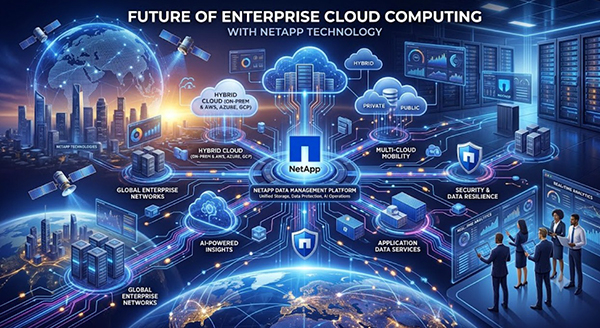
The Shift Toward Unified Hybrid Multi-Cloud Architectures
Historically, moving data between on-premises data centers and major public cloud providers (such as AWS, Microsoft Azure, and Google Cloud) required refactoring applications and building custom data pipelines. This created lock-in risks and fragmented visibility.
NetApp addresses this fragmentation through ONTAP, its flagship data management operating system. Rather than treating the cloud as a separate island, NetApp extends ONTAP natively across all major cloud environments. Products like Cloud Volumes ONTAP (CVO) and native hyperscaler services—such as Amazon FSx for NetApp ONTAP and Azure NetApp Files—allow enterprises to run the exact same data engine everywhere.
                     +---------------------------------------+
                     |    NetApp BlueXP Unified Control      |
                     +---------------------------------------+
                                         |
         +-------------------------------+-------------------------------+
         |                               |                               |
  +--------------+                +--------------+                +--------------+
  |  On-Premises |                |  AWS / Azure |                | Google Cloud |
  | ONTAP Arrays |                | NetApp Files |                | CVO Instances|
  +--------------+                +--------------+                +--------------+
Core Architecture Advantages
-
Consistent Operating Environment: Developers and storage administrators use identical APIs, management tools, and protocols (NFS, SMB, iSCSI) regardless of where data physically resides.
-
Seamless Data Mobility: Technologies like SnapMirror allow organizations to replicate, move, and sync workloads between on-premises environments and the cloud with minimal latency and zero application rewrites.
-
Single-Pane Management: Through NetApp BlueXP, IT operations gain centralized control plane visibility, automated data tiering, and policy enforcement across their entire global estate.
Fueling the Next Generation of Enterprise AI Workloads
The rapid adoption of Generative AI and Retrieval-Augmented Generation (RAG) models has fundamentally altered enterprise cloud priorities. High-performance AI pipelines require massive throughput, low latency, and efficient data preparation to feed hungry GPU clusters without bottlenecks.
Key Industry Realization: AI pipelines are inherently hybrid. Training often happens where computational power is optimized, while inference and data ingestion happen at the edge or within private clouds to protect sensitive IP.
NetApp’s AI-ready infrastructure—demonstrated through offerings like NetApp AIPod co-engineered with NVIDIA—bridges the gap between high-performance local clusters and cloud-based AI engines.
-
Unlocking Unstructured Data: Over 80% of enterprise data is unstructured (documents, images, audio). NetApp software structures and moves this data safely into AI pipelines.
-
Zero-Copy Cloning: Using FlexClone technology, data science teams can create instantaneous, space-efficient copies of multi-terabyte datasets for testing and fine-tuning models without incurring massive storage overhead or duplicating costs.
-
Data Provenance and Security: As regulatory frameworks around AI tighten, NetApp ensures data lineage, access controls, and compliance standards remain intact across multi-cloud AI workflows.
Cyber Resilience and Active Ransomware Defense
In modern enterprise cloud environments, traditional perimeter security is no longer sufficient. Cyber threats—particularly automated ransomware—have evolved to target backup infrastructure and data storage directly.
The future of cloud data management demands that storage systems act as the first line of defense. NetApp integrates autonomous threat detection directly into the storage hardware and software layer:
+-----------------------------------------------------------------------------------+
|                        NetApp Autonomous Ransomware Protection                    |
+-----------------------------------------------------------------------------------+
                                          |
          +-------------------------------+-------------------------------+
          |                               |                               |
  [ AI Access Analysis ]        [ Immutability Control ]      [ Automated Recovery ]
  Detects abnormal user or      Creates unalterable,          Restores petabytes of
  system behavior in real time  tamper-proof SnapLock         data in seconds via
  to block attacks [1.2.1].     copies instantly [1.2.5].     immutable snapshots [1.2.1].
By shifting from reactive data recovery to active cyber resilience, enterprises using NetApp technology can guarantee business continuity even during active security incidents.
Financial Optimization: FinOps and Storage-as-a-Service (STaaS)
Cloud adoption often brings unpredictable costs, commonly known as “cloud sticker shock.” As cloud storage footprints expand, managing storage tiering, performance requirements, and unallocated volumes becomes crucial for financial sustainability.
NetApp approaches cloud economics through two primary mechanisms: built-in efficiency algorithms and flexible consumption models.
1. Data Reduction & Automated Tiering
NetApp ONTAP employs inline deduplication, compression, and compaction before data hits disk or object storage. This frequently reduces cloud storage footprints by 50% to 80% compared to native raw cloud volumes. Additionally, automated policy-based tiering moves cold (infrequently accessed) data to lower-cost object storage tiers without altering application access paths.
2. Flexible Consumption with NetApp Keystone
To align with modern operational expenditure (OpEx) strategies, NetApp Keystone provides a flexible Storage-as-a-Service model. Organizations can scale their storage capacity up or down dynamically across on-premises data centers and public clouds, paying only for the performance tier and capacity they consume.
| Storage Requirement | Traditional Model | NetApp Keystone / Cloud Model |
| Capital Allocation | Upfront CapEx hardware purchases | Flexible OpEx consumption-based pricing |
| Capacity Management | Over-provisioning for 3-5 year growth | Dynamic scaling based on real-time demand |
| Multi-Cloud Mobility | Cloud-specific billing and storage formats | Unified SLA across on-prem and public cloud environments |
Summary: A Vision for the Autonomous Data Infrastructure
The future of enterprise cloud computing is not defined by where data is stored, but by how intelligently that data is managed, secured, and mobilized.
As enterprises navigate the complexities of multi-cloud architectures, edge computing, and artificial intelligence, NetApp technology provides the foundational architecture necessary for digital transformation. By unifying data operations under a single software-defined plane, automating cybersecurity defenses, and optimizing cloud economics, NetApp empowers organizations to turn disparate data into a secure, strategic engine for continuous innovation.